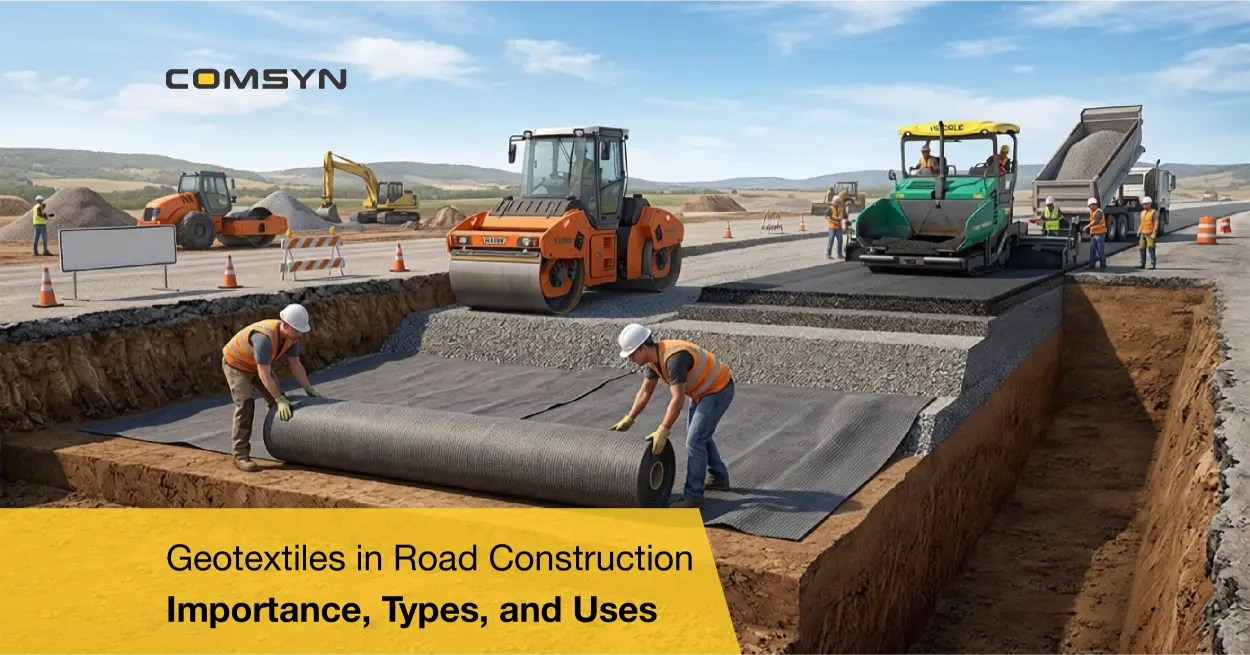
The infrastructure related to roads is considered the foundation for economic development across the globe–highways, rural roads, industrial corridors, and urban streets all require good durability and long-term operational performance. Geotextiles have revolutionized the way we build roads today. Geotextiles are widely used for projects in civil engineering and have several benefits, including improving soil stability, improving drainage, increasing pavement lifespan, and reducing maintenance costs. As demand for infrastructure grows, so too will the importance of geotextiles when building better and more sustainable roads. Textile materials of a permeable nature, such as polypropylene or polyester, can be called geotextiles. Permeable textile materials, otherwise known as geotextiles, are produced from synthetic (chemical) polymers; they can be used to increase the performance of engineering projects when placed between layers of soil or construction material. The variety of textile products available offers many different performance functions, including separation, filtration, reinforcement, drainage, and protection. Geotextiles are widely used in transportation infrastructure and geotechnical applications because of their ability to enhance interaction with soil. As a result of this ability to provide enhanced interaction between soil and structural elements, a variety of uses for geotextiles exist, including: roadways, railways, embankments, retaining walls, drainage systems, and projects involving erosion control. Roads are continuously subjected to vehicle loads, changing temperatures, water infiltration, and various other conditions. When roads are damaged due to weak subgrades or poor drainage systems, they can deteriorate early and result in ruts, cracks, potholes, etc. This is where the use of geotextiles in road construction plays an important role. 1. Increased Soil Stability Geotextiles can stabilize weak soils to allow for better distribution of loads across the road system, which will reduce differential settling, thus increasing the load-bearing capacity of the subgrade. 2. Increased Road Life Geotextiles help keep pavement layers from mixing with aggregate materials in the subgrade, which preserves the structural integrity of each layer and results in longer-lasting roads. 3. Improved Drainage Performance Water is one of the leading causes of road failure. Geotextiles allow water to pass through while preventing soil from clogging drainage systems. 4. Reduced Maintenance Costs Roads built with geotextiles have fewer structural failures, leading to less frequent repairs and ultimately lower long-term maintenance costs. 5. Sustainable Infrastructure Development By using geotextiles, there is a reduced need for continual aggregate replacement and rebuilding of infrastructure drives to ensure environmentally sustainable road construction practices. Geosynthetics have many different engineering uses, depending on the specific project requirements. Geosynthetics separate distinct soil layers to ensure water will flow through them, but that the two layers will not mix together, thus maintaining the integrity of the base layer and the sub-base layer. For example, geosynthetics allow a soft clay subgrade to be separated from a layer of crushed stone aggregate. Geosynthetics reinforce soft or weak soils by distributing traffic loads over a large area, thereby reducing how far the soil deforms under traffic loads. For example, geosynthetics are used to reinforce roads being built over soft or marshy ground. Geosynthetics allow water to flow through them while preventing soil particles from flowing through, thus maintaining the efficiency of any drainage system while preventing erosion. For example, geosynthetics are used in drainage systems or under pavements. There are geotextiles manufactured specifically as drainage media and to help collect water and move it away from the road structure. For example, geosynthetics are used for highway drainage systems and for retaining wall applications. Geotextiles can be used to protect geomembranes and other construction materials from being punctured or damaged mechanically. For example, geosynthetics have been successfully used as protective materials for landfill operations and waterproofing systems adjacent to roadways. Soil type, load demand, drainage needs, and project goals all affect what type of product to use. 1. Woven geotextiles are created from the weaving of synthetic yarns together to produce a strong, durable fabric. Characteristics: Typical Applications: Where reinforcement of soil is the main application, woven geotextiles are an effective option. 2. Non-woven geotextiles are made by binding together fibers with mechanical, thermal, or chemical methods. Characteristics: Typical Applications: These geotextiles provide excellent management for projects with a need to control the flow of water through them. 3. Knitted Geo-textiles are constructed from yarns that are looped together. Key Features: – Flexibility – Moderate reinforcement capability – Customized design properties Common Applications: – Specialized geotechnical construction projects – Soil reinforcement applications – Composite geoplastics systems While they do not have as much of a presence in the industry as either non-woven or woven products, knitted geo-textiles provide exceptional performance advantages for certain applications. Geotextiles are a very efficient material used for many different types of road projects. Geotextiles can help with poor soil by redistributing weight evenly and reducing the amount of settling of soil. When placed between the subgrade and aggregate layers, geotextiles help provide a stronger and longer-lasting pavement surface. Geotextiles can provide an inexpensive way to provide stability for a road built over soft soil. Geotextiles allow for support of large construction trucks and equipment traffic with minimal disturbance to the soil below. Geotextiles provide reinforcement of existing roadways during the reconstruction of a pavement, which increases the expected life of the pavement. When using geotextiles in drainage systems, geotextiles help provide for efficient flow of water while preventing the movement of soil particles. Geotextiles can help stabilize the embankment and limit erosion due to poor soil conditions in the construction of new roads on embankments. There are many different benefits of geotextiles, which are driving their increasing popularity. More specifically: Selecting an Appropriate Geotextile Requires Multiple Considerations: Working with an experienced Geotextile Manufacturer Will Help Ensure You Maximize Your Materials and achieve the Best Possible Results for Your Project. As transportation systems grow larger, engineers need to find solutions that will help ensure these systems are built to last and keep construction costs down. Geotextiles are one solution used to solve the most common problems encountered during the construction of roads, such as unstable soils, water management issues, and premature pavement failures. Geotextiles have proven to be an essential element in building modern infrastructure around the world because they help provide stability, improve drainage, and extend pavement life. Geotextiles’ important contributions are no longer limited to acting as secondary materials in road construction; rather, in fact, they play an integral role in engineering solutions. Geotextiles can provide better performance and longer lifespan for roadways through their many uses, such as separation filter, reinforcement, and drainage, than previously thought. Through knowing the various geotextile membrane fabrics and their respective usages, engineers, contractors, and infrastructure developers can make appropriate choices for each project. With sustainable, durable, and cost-effective road construction, the use of geotextiles is sure to be a major factor in the development of future transport infrastructure. Are You Looking For High-Quality Geotextile Products? At Comsyn, we offer the highest quality manufactured geotextiles designed specifically for road construction and soil stabilization, as well as drainage and other infrastructure projects/civil engineering requirements. Our products provide high levels of durability, superior performance, and outstanding long-term return on investment for very demanding applications. For more information about where you can find the best geotextile fabric for your next project, contact our professionals today. The geosynthetic product line of Comsyn includes a complete assortment of geotextile fabrics, as well as ground cover and erosion control. Road geotextiles are permeable, synthetic materials positioned between the embedded soil and aggregate layers that assist in strengthening the roadway, promoting drainage, keeping the soil and aggregates separated, and prolonging the pavement’s service life. The “best” geotextiles for road construction will differ by application. Woven geotextiles are generally used for soil stabilization and reinforcement applications, whereas nonwoven geotextiles are preferred for filtration and drainage applications. Geotextiles help to distribute the load over the entire base of the structure, minimize rutting and settlement, improve drainage, and reduce contamination between the soil and aggregate layers, which creates stronger and longer-lasting roads. Common applications for geotextiles in road construction include highways, rural roads, temporary access roads, embankments, pavement rehabilitation projects, drainage systems, and areas where soil conditions are weak or unstable.Geotextiles in Road Construction: Importance, Types, and Uses
What Are Geotextiles?
Importance of Geotextiles in Road Construction
Functions of Geotextiles in Road Construction
Types of Geotextile Membrane Fabrics
Major Geotextile Applications in Road Construction
Benefits of Using Geotextiles in Road Construction
Factors to Consider When Selecting Geotextiles
Why Are Geotextiles Essential for Modern Road Infrastructure?
Conclusion
FAQS

- About Us
- Products
- Markets Served
-
- Investor Relation
- Board Of Directors
- Committees Of Board
- Corporate Governance
- Financials
- Annual Report
- Key Managerial Positions
- Shareholding Pattern
- Notices
- Policies Programme
- Announcements
- Statement of Investor Complaints
- Unpaid & Unclaimed Dividend
- Prospectus
- Investors Contact
- Subsidiary Financials
- IEPF
- Preferential Issue – 2024
- MOA & AOA
- Integrated Filing
- Sustainability
- Contact Us
- TechTex
- Brochure