Pond liners used in agriculture, aquaculture, and industrial water management are expected to deliver safe, dependable performance for years—often decades. However, one of the most common reasons for leaks, water loss, and costly repairs is damage to the pond liner itself. Such damage may occur due to sharp materials beneath the liner, soil settlement, root penetration, or continuous hydraulic (hydrostatic) pressure acting on the liner over time. To address these challenges, modern pond lining systems increasingly rely on geotextile fabric as a critical component of waterproofing design. Rather than functioning as a standalone layer, geotextiles work in conjunction with liners to protect, stabilize, and extend system life. This article explains how geotextile fabric for waterproofing enhances the durability of pond liners by improving stress distribution, puncture resistance, and long-term performance. Geotextiles primarily act as an intermediate protective layer between the subgrade (soil base) and the pond liner. Without this layer, liners are directly exposed to uneven subgrades, sharp stones, coarse aggregates, and ongoing soil movement—factors that significantly accelerate liner degradation. When geotextile fabric is incorporated into pond waterproofing systems, the liner benefits from: Rather than forcing the liner alone to absorb mechanical and environmental stress, geotextiles help form a composite system where each layer reinforces the other. This layered design is the key reason geotextile-reinforced pond lining systems consistently outperform liner-only installations in terms of longevity. In practice, the effectiveness of this system depends on factors such as soil type, pond depth, liner material, and loading conditions. This is why pond lining solutions are increasingly specified as integrated liner–geotextile assemblies rather than generic, single-layer designs. Manufacturers such as Comsyn work closely with project stakeholders to align geotextile specifications with real site conditions, helping reduce long-term performance risk. Beyond separation, geotextiles contribute multiple protective functions within pond lining systems: By supporting the liner across its entire surface, geotextiles help prevent micro-damage—small failures that may go unnoticed initially but often lead to premature liner failure over time. Traditional pond lining methods have inherent limitations. Clay liners can crack and lose integrity during dry conditions. Concrete, being rigid, is prone to cracking and expensive repairs. Plastic liners, while flexible, offer little resistance to puncture or abrasion when used alone. Geotextile-supported liners overcome these limitations by accommodating environmental changes while protecting the liner from localized failure. The flexibility of the system allows it to absorb mechanical stress, adapt to subgrade variability, and maintain waterproofing integrity under dynamic site conditions. Over extended service periods, ponds lined with geotextile-supported systems consistently outperform conventional methods in terms of durability and reduced maintenance costs. Among waterproofing materials used in pond applications, polypropylene geotextile is widely regarded as the most reliable option. Its molecular structure provides high mechanical strength while retaining flexibility. Key advantages include: Unlike natural or hybrid fiber geotextiles, polypropylene geotextiles maintain consistent physical properties over time, making them suitable for permanent pond installations. Although geotextiles are typically installed beneath liners, limited edge exposure during installation or service life is possible. Polypropylene geotextiles are engineered with UV stabilization to minimize degradation during these periods. In industrial and effluent containment ponds, chemical resistance is critical. Polypropylene geotextiles exhibit strong resistance to acids, bases, saline environments, and hydrocarbons, allowing them to perform reliably in aggressive conditions where other materials may fail. Puncture resistance is one of the primary reasons geotextile fabrics significantly extend liner life. Sharp stones, compacted gravel, and root intrusion create localized pressure points that can damage liners over time. Geotextiles distribute these concentrated loads across a wider surface area, reducing stress concentrations and preventing liner penetration—especially important for: Preventing even small punctures is critical, as slow leaks often remain undetected until significant damage has occurred. Pond environments are rarely static. Water levels fluctuate, soils expand and contract, and external forces introduce gradual changes over time. Geotextile fabric enables pond lining systems to adapt to these conditions while maintaining continuous liner support. The ability of geotextiles to conform to subgrade contours without compromising liner protection is a key reason geotextile-lined ponds continue to perform reliably over long operational lifespans. Water retention and contamination control are essential in agricultural irrigation ponds and aquaculture systems. Waterproofing helps protect liners from damage caused by: By extending liner life and reducing repair frequency, geotextiles help minimize downtime, stabilize water quality, and maintain consistent pond levels—critical factors for agricultural productivity and aquaculture viability. Industrial and effluent ponds are subject to chemical exposure, temperature variation, and higher mechanical loads. Polypropylene geotextiles provide the durability required to withstand these harsh conditions while maintaining liner integrity. Their resistance to chemical degradation and mechanical fatigue reduces long-term environmental risk and compliance-related costs, making them a reliable choice for industrial containment applications. While the initial inclusion of geotextile fabric may increase upfront costs, long-term savings are substantial: Over the full lifecycle of a pond, geotextile-supported systems consistently deliver better ROI than liner-only or traditional alternatives. Selecting the appropriate geotextile depends on several factors: Heavier nonwoven polypropylene geotextiles are typically used for high-risk or long-term projects, while lighter grades may suffice for low-load applications. Operators who incorporate geotextile fabric into pond waterproofing systems achieve longer service life, improved performance, and reduced lifecycle costs across agricultural, aquaculture, and industrial applications. By reinforcing liners and adapting to real-world site conditions, geotextiles offer a durable and future-ready approach to water storage and containment. For projects requiring puncture-resistant, chemically stable, and long-lasting geotextile solutions, polypropylene-based fabrics have proven to deliver consistent results. To explore suitable geotextile fabric options for pond lining applications, visit Comsyn or consult their technical team for project-specific guidance. Punctures are reduced with the use of geotextiles, load distribution is provided, and mechanical stress is absorbed; therefore, early damage to liners will be minimized. Correct. Due to the adaptation of a geotextile to the movement in the soil, the liner will have continuous support, thus reducing the potential for leaks resulting from settlement. Yes. Geotextiles have been proven to work with commonly used liner materials such as HDPE, PVC, and many other manufactured liners. Absolutely. The cushioning ability of the geotextile, combined with its load distribution properties, will greatly reduce the possibility of sharp object damage. The thickness of the geotextile required for pond waterproofing will depend upon the liner type, the load (as defined above), and the condition of the subgrade, as well as the depth of the pond.Why Geotextile Fabric for Waterproofing Pond Lining Lasts Longer?
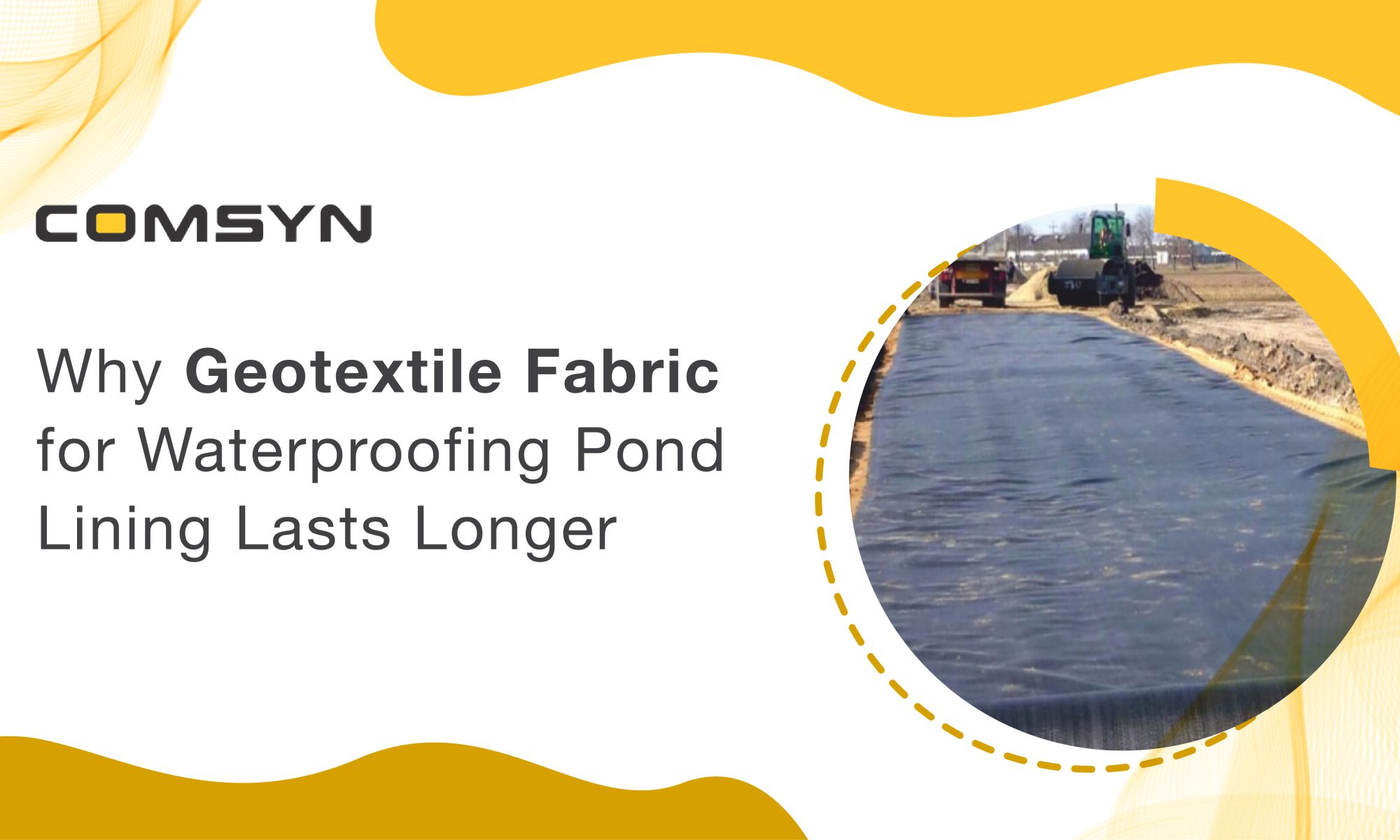
Geotextile Fabric for Waterproofing in Pond Lining Systems
Fabric for Waterproofing and Its Role in Pond Protection
Geotextile Fabric for Waterproofing vs Conventional Pond Liners
Fabric for Waterproofing Compared to Clay, Concrete, and Plastic Liners
Polypropylene Geotextile – Material Strength and Durability
UV Resistance, Chemical Stability, and Long-Term Performance
Puncture Resistance and Structural Protection
Geotextile Fabric for Waterproofing in Real-World Pond Applications
Fabric for Waterproofing in Agriculture and Aquaculture Ponds
Polypropylene Geotextile for Industrial and Effluent Containment
Geotextile Fabric for Waterproofing – Cost, Longevity, and Selection
Lifecycle Cost vs Traditional Pond Liners
Choosing the Right Fabric for Waterproofing Based on Site Conditions
Conclusion
FAQs

- About Us
- Products
- Markets Served
-
- Investor Relation
- Board Of Directors
- Committees Of Board
- Corporate Governance
- Financials
- Annual Report
- Key Managerial Positions
- Shareholding Pattern
- Notices
- Policies Programme
- Announcements
- Statement of Investor Complaints
- Unpaid & Unclaimed Dividend
- Prospectus
- Investors Contact
- Subsidiary Financials
- IEPF
- Preferential Issue – 2024
- MOA & AOA
- Integrated Filing
- Sustainability
- Contact Us
- TechTex
- Brochure