Walk through the rice aisle of a large supermarket and one thing becomes obvious fairly quickly: packaging has become part of the product story. Some bags compete on heritage. Others lean heavily on origin, grain length, aroma or premium cues. Then there are export-focused brands that need a pack to look convincing not only on a retail shelf, but also after cartons, pallets, warehouses and multiple handling points. That puts far more pressure on BOPP Rice Bags than simply holding the product safely. For rice producers, exporters and private-label businesses, printing therefore deserves more attention than it often gets. The wrong print specification can make expensive artwork look ordinary. The right one can make the pack easier to recognise, easier to trust and considerably stronger at the point of sale. One of the easiest mistakes in packaging development is to design first and discuss production later. A creative team may produce a beautiful layout with deep gradients, detailed rice-field photography, metallic accents and several colour transitions. Then the procurement team sends it to the packaging manufacturer and discovers that the artwork needs to be modified for the selected process, bag construction or budget. That sequence is backwards. The efficient printing of BOPP rice bags depends on consideration of production requirements as the identity of the product is developed. For instance, a 5 kg premium basmati pack sold through retail can require a very different type of visual identity than a high-volume 25 kg pack sold through wholesalers. The printing quality of both bags should be good, but what is good here can differ. Volume, SKU count and complexity of artwork count too. If a brand changes its designs often, that matters too. The printing should be able to follow the requirements of the project the printing is needed for. For brands using detailed graphics and running repeat packaging volumes, gravure printing is an important option to consider. The engraving cylinders are utilized for transferring images. This makes it effective for designs that depend on colour consistency, delicate designs, photography and solid colours. This is why gravure used for printing rice bags is mostly used in premium retail programs. This is clear by the use of rice images as they allow achieving higher accuracy in calibration. The gradients at the background can be smoothed, as well as keeping brand colours stable during the whole production. However, there is a hidden side to it. Engraving cylinders require an investment upfront. If the packaging changes every month or there is a large number of varieties with the low production volume, the investment is hard to justify. In case of a stable brand that makes repeated orders, gravure printed rice bags can work. That conversation can save money later. There is a tendency in premium packaging to confuse sophistication with complexity. It is usually a mistake. The best custom printed BOPP rice bags do not necessarily contain more visual elements. Quite often, they contain fewer — but those elements have a clear job. A shopper should be able to identify the brand quickly. The rice variety should not require searching. Pack size should be easy to locate. If origin, ageing, grain characteristics or another legitimate differentiator matters to the buying decision, it should have an obvious place in the hierarchy. The remaining information can work harder on secondary panels. This is where disciplined artwork wins. A pack covered with badges, seals, product claims, photographs, decorative borders and competing typefaces may technically communicate more information while making the product harder to understand. Premium packaging needs confidence. Sometimes the most effective design decision is knowing what not to print. Finish is often discussed as an aesthetic choice. It is actually a positioning decision. Gloss is known to infuse printed colors with more power. It may serve well if the goal is to make products lively, inviting and easy to notice. The effect of matte is quite different. In this case, the effect is often more subtle which implies a premium and more understated identity. Metallic finishes have an additional degree of differentiation, but they often come along well with well-targeted application rather than a busy design. Comsyn is a supplier of BOPP based packaging that can be customized in terms of printing, coatings and finishes as well as matte, gloss and metallic finish types. The crucial thing for brand managers is to avoid making a decision based on the sample book only. Check how it works with the design. The dark premium design may behave differently in terms of matte finish than the amber design made with red, yellow colors and high-contrast photography. It is tempting to treat printing and bag construction as separate subjects. In production, they are closely connected. Laminated rice packaging bags are expected to do two jobs at once. They must deliver the visual surface required by the brand while providing the practical strength expected from woven packaging. That balance matters once the bag enters distribution. Think about what happens after printing. The package is filled. It may be stacked. It may rub against neighbouring bags. It may move through warehouses, transport vehicles and dealer networks before reaching the consumer. An impressive render on a designer’s screen tells you very little about how the finished pack will look after that journey. That is why buyers assessing laminated rice packaging bags should review physical samples whenever feasible. Look at print appearance, folds, seams, closure areas and how the graphics sit once the bag is actually filled. A beautiful flat artwork can behave very differently in three dimensions. Printing has three practical jobs. First, it should create recognition. A buyer who has purchased the brand before should be able to spot it quickly. Second, it should establish hierarchy. Brand, product variant and essential buying information should not compete for attention. Third, it should retain enough visual integrity through handling that the pack still represents the brand properly when it reaches the selling environment. Those principles sound obvious. They are surprisingly easy to lose once multiple internal teams start adding requirements. Marketing wants another message. Sales wants a promotional callout. Legal needs declarations. Export teams need additional information. Operations need codes and manufacturing details. By the time everyone has contributed, the front of the bag can become crowded. A disciplined BOPP rice bag printing program separates information that helps sell the product from information that simply needs to be present. Price per bag is important, but it is a poor standalone measure for selecting a packaging partner. A custom rice bags manufacturer should be able to discuss the relationship between artwork, production volume, print process, lamination, bag size and end-use conditions. Before requesting a quotation, it helps to provide a proper brief rather than simply sending a PDF artwork. Include expected quantities, pack weights, number of designs, target markets, preferred finish and any specific filling or handling requirements. Ask how colour approval is handled. Ask what happens when artwork changes. Ask whether the proposed specification makes sense for the expected run size. A good custom rice bags manufacturer should be prepared to discuss these questions because they influence both cost and the finished result. Comsyn manufactures BOPP laminated woven bags as part of its wider woven packaging portfolio. The BOPP capabilities published by the company come with different options like engraved-cylinder printing, customizing and multicolor printing which makes it useful for rice brands looking to do more than just package commodities. The importance of this fact comes from the realization that it is very rare for custom printed BOPP bags for rice to be successful relying on only one element instead of system. The picture, the design, the printing process, lamination, finishing and the making of the bag have to work together. When speaking about a new rice brand, the conversation would revolve around how to achieve strong shelf presence without overcomplicating the design and production of the package. An existing exporter would speak only about getting constant look for the repeated products. Another customer may be just interested in moving from buying a simple woven sack to relying on high-quality packaging solutions that would not complicate the logistic process. There is no standard specification when it comes to printing that makes a bag of rice premium. Even if a bag design is heavily embellished, it can still appear to be cheap. On the other hand, a simpler design that is executed correctly in terms of color coordination, finishing and usage of materials can appear to be far more impactful. The best premium rice packaging bags have one thing in common: each visual component of the bag is purposeful. This is where planning has to begin. Prior to finalizing the BOPP rice bags for your upcoming project, be sure to review the artwork in relation to the quantity of units, finishing, construction and distribution process of the bags as well. Comsyn works with businesses across woven packaging requirements, including BOPP formats. If you are developing a new rice packaging program or reviewing an existing specification, connect with the Comsyn team to discuss the bag construction, printing and customization requirements for your market. Due to gravure printing’s ability to produce high-quality images and colour graphics, gravure printing is often used for large print jobs. Nevertheless, one must still carefully consider which process to use depending on the order volume, artwork and business needs. Yes. BOPP packaging can support detailed printed graphics, including product photography and complex visual designs. Artwork should be developed with the selected printing process and finished bag construction in mind. They can be produced for different packaging requirements and pack sizes. The appropriate construction should be discussed with the manufacturer based on filling, handling, transport and storage conditions. Share the required bag size or product weight, order quantity, number of SKUs, artwork, preferred finish, destination market and any filling or handling requirements. A more complete brief generally leads to a more relevant packaging recommendation. Neither finish is inherently more premium. Matte often creates a restrained visual character, while gloss can make colours appear brighter and more prominent. The better choice depends on the brand design and the shelf impression you want to create.BOPP Rice Bags: Premium Printing & Finish Options
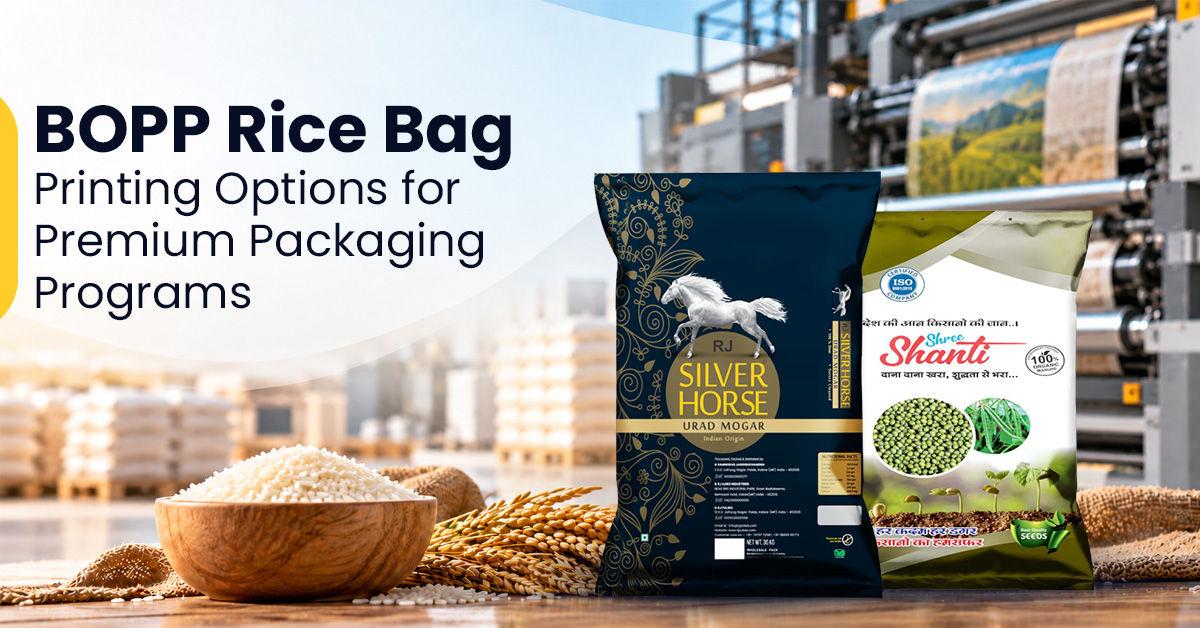
Why Printing Decisions for BOPP Rice Bags Start Before Artwork
Gravure Printing: Where It Makes Commercial Sense
Custom Printing Should Make the Brand Easier to Buy
Matte, Gloss and Metallic Finishes Create Different Brand Signals
Lamination Is Part of the Visual Result
What Good BOPP Rice Bag Printing Should Achieve
Choosing a Custom Rice Bags Manufacturer
Where Comsyn Fits into Premium Rice Packaging Programs
Premium Packaging Is Usually the Result of Better Decisions, Not More Decoration
Frequently Asked Questions
What printing method is suitable for premium BOPP rice bags?
Can BOPP rice bags use photographic designs?
Are laminated rice packaging bags suitable for large rice packs?
What information should I provide when asking for custom printed rice bags?
Is matte or gloss better for premium rice packaging bags?

- About Us
- Products
- Markets Served
-
- Investor Relation
- Board Of Directors
- Committees Of Board
- Corporate Governance
- Financials
- Annual Report
- Key Managerial Positions
- Shareholding Pattern
- Notices
- Policies Programme
- Announcements
- Statement of Investor Complaints
- Unpaid & Unclaimed Dividend
- Prospectus
- Investors Contact
- Subsidiary Financials
- IEPF
- Preferential Issue – 2024
- MOA & AOA
- Integrated Filing
- Sustainability
- Contact Us
- TechTex
- Brochure