A packaging sample can look excellent on a meeting-room table and still become a problem once thousands of filled bags start moving through production, warehousing and distribution. That is precisely why evaluating a BOPP Laminated Bag before approving a large purchase needs to go well beyond colour, finish and price. For procurement teams, packaging managers and brand owners, the real question is not simply, “Does this bag look good?” It is whether the bag will perform consistently when filled, stacked, handled, transported and displayed. A weak seam, inconsistent lamination or slight variation in dimensions may seem minor during sampling. Multiply it across a large order, however, and the result can be damaged products, packing-line interruptions, poor shelf presentation or unnecessary wastage. So, what should you actually check before signing off on production? A high-quality bag is the result of several elements working together: woven fabric strength, lamination consistency, print quality, dimensions, stitching and the suitability of the bag construction for the product being packed. BOPP laminated woven bags bring together the tensile strength of woven polypropylene and printed BOPP film, which provides protection, as well as great visual appearance for the bags. Their versatility means they can be used in such industries as agriculture (food grains, seeds, etc.), fertilizer industry, animal nutrition industry, chemical industry and construction industry. The point to be made here is the fact that quality cannot be determined only by one characteristic feature. A glossy surface is of no use if the bags are of bad make, just like any sturdy fabric will not help if the printing is misaligned and the bottom seam is broken. A proper BOPP bags quality control process therefore examines the complete package. Before inspecting anything physically, compare the sample against your approved technical specification. Start by checking dimensions, fabric construction, weight of the bag, whether there’s any need for lamination, printing, the make of top and bottom part, the color, whether UV is applicable, the requirements for liner and any other features applicable. Why to begin with? Because even though the bag may have been perfectly manufactured it could still be utterly wrong for your needs. For instance, the packaging needs for the agricultural products, pet food, rice or construction materials are not the same. All details like filling machines, density of products, moisture sensitivity, stacking and logistics may change the bag’s construction. The company Comsyn itself manufactures a variety of specifications and combinations in terms of width, mesh and denier, closures, lamination and so on. Your checklist, therefore, should start with one question. Does the supplied bag match the specification approved by you? The woven polypropylene fabric forms the structural backbone of the package. Inspect the bag for visibly uneven weaving, loose tapes, gaps, distorted fabric or irregularities around seams and folds. The material should feel consistent throughout the sample rather than noticeably stronger in one section and weaker in another. Then consider how the bag will behave after filling. Will it maintain its shape during stacking? Can it tolerate routine movement through warehouses and transport networks? Does the construction suit the expected packed weight? For any BOPP bags bulk order, evaluating the bag in its filled condition is far more useful than examining an empty sample alone. An empty bag can hide weaknesses that become obvious only under load. Where appropriate, ask your supplier what quality checks are performed during manufacturing and what testing is applicable to your specification. Lamination affects much more than appearance. It contributes to surface protection, printing performance and resistance to moisture encountered during normal handling and storage. Inspect the entire surface of the BOPP Laminated Bag under good lighting. Check for blisters, creases, areas that are peeling, where the bond appears uneven and any trapped dirt and other impurities as well as where the film does not appear to adhere well to the woven substrate. Careful attention should be paid to the folds and edges as these areas face a high amount of strain during the processes of conversion, packaging, and handling. Try to bend the product against itself without tearing it apart. When comparing the laminates from different suppliers, do not judge based on the shininess of the product. Packaging has two jobs. It protects the product, but it also represents the brand. Stand a few feet away from the sample and look at it as it would appear on a pallet or retail shelf. Are the colours consistent? Is small text readable? Are logos sharp? Is print registration accurate? Do graphics line up correctly around gussets, seams and edges? Then look closer for smudging, distortion, colour variation or weak image definition. High-quality BOPP laminated woven bags allow brands to use detailed graphics and strong surface presentation. Comsyn lists printing precision, clarity, gloss and custom finishes among the features available within its BOPP offering. For branded packaging, print consistency should form a documented part of BOPP bags quality control, not an informal visual preference. A bag often fails at its weakest point, and that point is frequently a seam. Check whether stitching is straight and consistent. Look for loose threads, skipped stitches, damaged areas, uneven folds and inadequate closure. The exact inspection depends on the construction you order. Bags may use different top treatments, bottom stitching arrangements, gussets, liners, valves or easy-open features. Your BOPP bag inspection checklist should therefore be customised to the actual bag design rather than copied from a generic procurement template. One practical test is remarkably simple: fill sample bags with the intended product or a material of comparable weight, move them through normal handling conditions and observe what happens. Real handling frequently reveals issues that visual inspection misses. A difference of a few millimetres may sound insignificant until bags start running through automated or semi-automated filling equipment. Check for blisters, creases, areas that are peeling, where the bond appears uneven and any trapped dirt and other impurities as well as where the film does not appear to adhere well to the woven substrate. Careful attention should be paid to the folds and edges as these areas face a high amount of strain during the processes of conversion, packaging, and handling. Try to bend the product against itself without tearing it apart. When comparing the laminates from different suppliers, do not judge based on the shininess of the product. This is especially important before a sizeable BOPP bags bulk order because dimensional inconsistencies can affect operational productivity as much as packaging appearance. Moisture resistance is one reason BOPP packaging is widely used for products such as grains, seeds, fertilizers, chemicals and other materials that require protection during storage and distribution. Comsyn also identifies moisture resistance as a key advantage of its BOPP offering. But “moisture resistant” should never replace application-specific evaluation. Consider how long your product will remain packed, where it will be stored, the climate it may encounter and whether an additional liner is necessary. If moisture protection is commercially important, discuss appropriate construction with your BOPP bags supplier rather than relying only on a generic bag specification. One perfect sample proves very little. Request multiple samples or evaluate pieces from a representative production batch. Compare dimensions, print shades, lamination, stitching and overall finish. Consistency matters because industrial packaging is purchased at scale. Your customer does not experience the “best sample”; they experience whichever bag reaches them. This is where the manufacturing and quality system behind the packaging becomes important. Good inspection reduces risk. Good manufacturing systems reduce the chances of that risk appearing in the first place. The dependable BOPP bag supplier should be able to understand the application, translate that into an appropriate specification, and hold that specification throughout production. Comsyn claims to have its own in-house quality control department, which performs quality checks at several levels, from the materials and inputs to the finished product. They have a range of BOPP type products, from prints, lamination, gusseted features, back seams, and other fit-for-purpose solutions. Such capabilities allow for packaging problems to be solved and conceived not as just a transaction but as a chain within the wider procurement activities. Prior to giving the go-ahead for production, make sure to verify specifications and measurements, evaluate textile uniformity, test the bond of the lamination, ensure that the print is correctly registered and coloured, check the stitching and closing mechanisms, run filling and manipulation tests, confirm the moisture protection needs along with comparing many samples to see if they are alike. Above all, record what has been approved. Having a signed physical sample or a clear technological specification provides both the buyer and the manufacturer with a quality standard for production. The smartest time to discover a packaging problem is before thousands of units have been produced. Evaluating a BOPP Laminated Bag properly means looking beyond surface appearance to fabric construction, lamination, printing, seams, dimensions, filling behaviour and batch consistency. A disciplined approval process may take slightly more effort upfront, but it can prevent far more expensive problems later. If you are planning a new packaging requirement or evaluating options for your next bulk purchase, speak with Comsyn about the product, filling process, handling conditions and branding requirements behind the bag—not simply the dimensions. The right packaging starts with the right specification. Talk to Comsyn about your BOPP packaging requirement and request a customised solution. First off, check the bag using the specification of approval. Validate the fabric quality, size, lamination adherence, print appearance, stitching, fastening and the complete work quality. In case of a commercial order, filling and handling teams need to test the bag as well for final approval. A practical inspection should cover dimensions, fabric construction, lamination, graphics and print registration, seams, stitching, closures, liners or gussets where applicable, filled-bag behaviour and consistency across multiple samples. Look beyond unit price. Assess the manufacturer’s production capability, quality-control process, customisation options, technical understanding of your application and ability to maintain consistent specifications across repeat orders. Common warning signs include uneven weaving, loose tapes, wrinkles, bubbles or separation in the lamination, poor print registration, colour variation, inconsistent dimensions, skipped stitches and weak seams. The relevance of each defect depends on the intended application. The answer is affirmative. An ideal sample evaluation should consist of the measurement of the sample, visual inspection, as well as a realistic filling, handling, and stacking trial. Using a sample under conditions that are close to real life will give much more relevant information than merely approving an empty sample based on its appearance.BOPP Laminated Bag Quality Checklist Before Bulk Orders
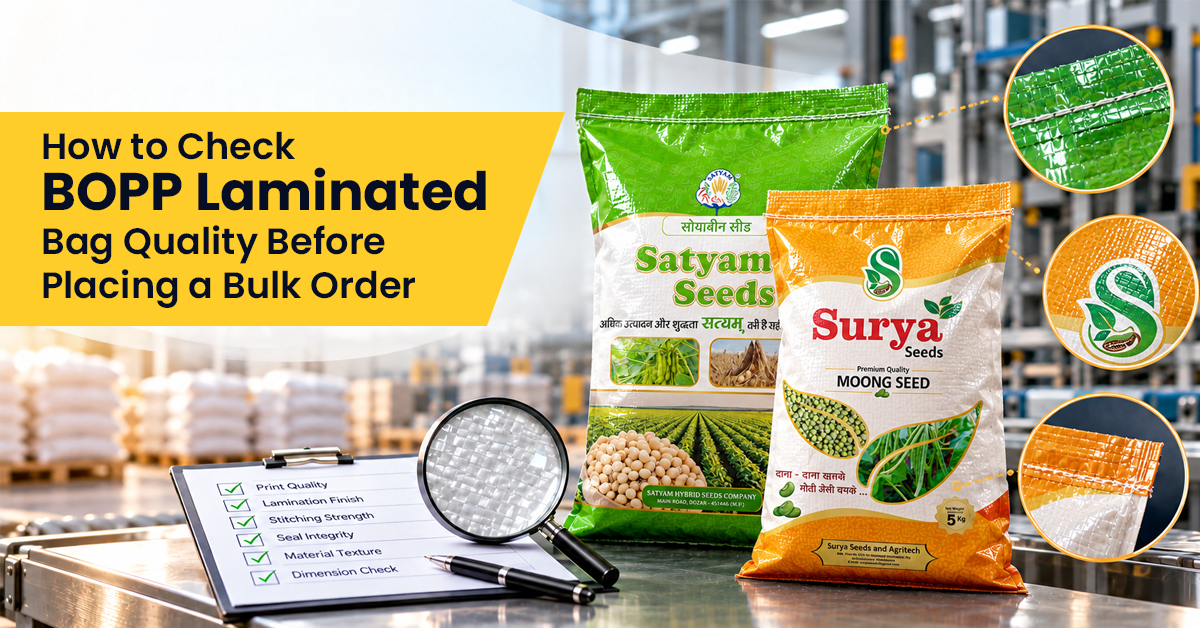
What Determines the Quality of a BOPP Laminated Bag?
1. Start With the Bag Specification, Not the Sample Appearance
2. Examine the Woven Fabric and Structural Strength
3. Check Lamination for Uniformity and Adhesion
4. Inspect Printing Like a Customer Would
5. Inspect Stitching, Seams and Closures Carefully
6. Test Dimensions and Filling Compatibility
7. Evaluate Moisture Protection for the Actual Product
8. Check Consistency Across Multiple Samples
Why Supplier Quality Systems Matter Before a Bulk Order
A Practical Pre-Order Checklist
Inspect the Bag Before You Commit to the Volume
Frequently Asked Questions
How do you check the quality of BOPP bags?
What should be included in a BOPP bag inspection checklist?
How do you choose a reliable BOPP bags supplier?
What defects should I look for in BOPP laminated woven bags?
Should I test samples before placing a bulk order?

- About Us
- Products
- Markets Served
-
- Investor Relation
- Board Of Directors
- Committees Of Board
- Corporate Governance
- Financials
- Annual Report
- Key Managerial Positions
- Shareholding Pattern
- Notices
- Policies Programme
- Announcements
- Statement of Investor Complaints
- Unpaid & Unclaimed Dividend
- Prospectus
- Investors Contact
- Subsidiary Financials
- IEPF
- Preferential Issue – 2024
- MOA & AOA
- Integrated Filing
- Sustainability
- Contact Us
- TechTex
- Brochure