Modern infrastructure will continue to feel the burden of a demand for a balance of cost-efficiency, durability, and sustainability in 2025. Engineers are increasingly turning to geosynthetics—high-performance polymer-based materials that are used for soil stabilization, erosion control, and performance enhancement—with applications ranging from highways and embankments to landfills and railways. Geosynthetics offer unique advantages for building stability and reliability when faced with weak subgrades, minimizing environmental impact, and extending the life of infrastructure. Comsyn is proud to be an impactful leader in this transformation with its disruptive geosynthetic products engineered for durability and environmental performance across a variety of industries. Geosynthetics are synthetic materials manufactured with polymers, which can include polypropylene, polyethylene, or polyester, that can be used to improve the performance of soil in geotechnical engineering applications. Geosynthetics serve important functions in separation, drainage, filtration, reinforcement, and containment. Geosynthetics have been applied in infrastructure projects across the world, addressing issues related to soil instability, erosion, or limits to bearing capabilities. Using geosynthetics has transitioned into an essential tool in current construction practices due to engineered quality, flexibility, and low cost. There are different varieties of geosynthetics, and each type serves a specific function based on the needs of the project. Typical geosynthetics include geotextiles, geogrids, geomembranes, geocells, geonets, geopipes, geofoam, and geosynthetic clay liners (GCLs)—each constructed for a specific soil stabilization function. Geotextiles are either woven or non-woven fabrics that function as separators, filters, and stabilizers. Geotextiles will isolate soil types within soil layers with some type of controlled water flow and promote support of the subgrade under situations with road embankments and drainage. Geogrids are rigid or flexible composites that consist of grids shaped by polymers. They interact with previously placed soil types or aggregates to reinforce the soil. The geogrid enhances load distribution and resists deformation, as well as improves the stability of pavement sections, retaining walls, and embankments. Geomembranes, made of impermeable sheets of polymers, provide effective containment against the movement of liquids and gases. They are very important in landfill liners, ponds and reservoirs, and tunnel construction by providing effective and long-lasting containment that protects the environment. Geocells consist of polymer strips connected to other strips to form a honeycomb matrix that is then filled with soil or aggregate. Geocells provide a beneficial load distribution, erosion control, and slope stabilization, especially where soft ground exists. The net-like structure of geonets is made of polymer and facilitates the movement of fluids through soils. Geonets are frequently used in the construction of drainage layers, where they manage leachate in landfills and control groundwater pressures around retaining structures. Solid or perforated polymeric pipes that transport fluids or gases through soil systems (e.g., subsurface drainage and landfill gas management). Lightweight expanded polystyrene blocks, or geofoam, can effectively reduce the loading of weak subgrades. They work well in bridge approaches, retaining walls, and as lightweight fill for slope fills when weight is a key factor. GCLs consist of bentonite clay held between two layers of geotextile and provide a low-permeability barrier. GCLs can be low-cost, effective alternatives or companions to geomembranes in containment systems. Each of the types of geosynthetics mentioned above has its own mechanical and hydraulic properties, which enable engineers to select the best combination of materials for site-specific applications. The various types of geosynthetics are useful for their ability to accomplish multiple functions at the same time: Geosynthetics improve the overall performance and longevity of infrastructure systems through one or more of these functions. Various types of geosynthetics are changing the way engineers address complicated ground conditions in civil and environmental projects: In each case, improved stability, cost savings, and sustainability all improve with the right combination of types of geosynthetic. The increasing use of geosynthetics in 2025 illustrates the unrivaled benefits of geosynthetics compared to traditional soil stabilization techniques: Comsyn is considered a trusted partner that provides globally-competitive geosynthetics solutions “made for the specific conditions of infrastructure projects. From highways to landfills, the varieties of geosynthetics are changing construction practices with increased stability, performance, and sustainability. Their abilities to reinforce, protect, and enhance soil systems make them key components of infrastructure systems in 2025. With innovation, quality, and thoughtful design, Comsyn continues to drive the future of construction with sustainable geosynthetic solutions that fortify foundations and the future. With quality installation, they can last for decades. Yes, geomembranes and GCLs are made with excellent chemical resistance. Yes, appropriate types like geotextiles and geocells are ideal for hydraulic conditions. Yes, most roll and modular systems work easily with robotic and automated systems.Types of Geosynthetics Revolutionize Construction in 2025
What Are Geosynthetics?
Types of Geosynthetics
1. Geotextiles
2. Geogrids
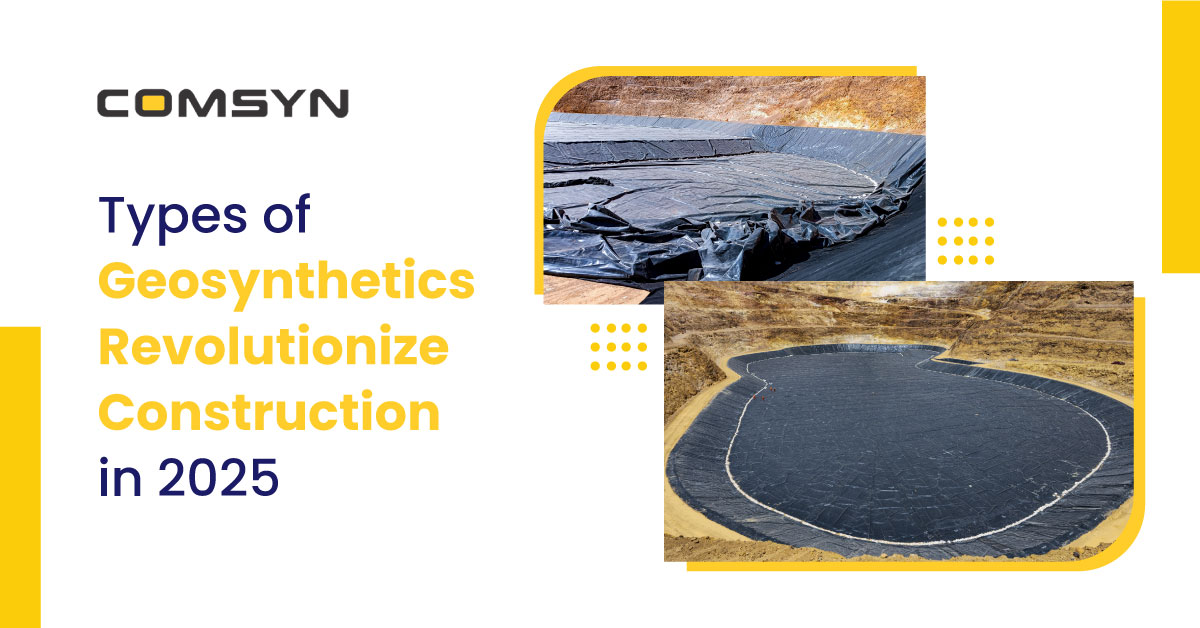
3. Geomembranes
4. Geocells
5. Geonets
6. Geopipes
7. Geofoam
8. Geosynthetic Clay Liners (GCLs)
Functions of Geosynthetics
Applications of Geosynthetics in Soil Stabilization
Benefits of Geosynthetics
Why Choose Comsyn for Geosynthetic Solutions?
Conclusion
FAQs

- About Us
- Products
- Markets Served
-
- Investor Relation
- Board Of Directors
- Committees Of Board
- Corporate Governance
- Financials
- Annual Report
- Key Managerial Positions
- Shareholding Pattern
- Notices
- Policies Programme
- Announcements
- Statement of Investor Complaints
- Unpaid & Unclaimed Dividend
- Prospectus
- Investors Contact
- Subsidiary Financials
- IEPF
- Preferential Issue – 2024
- MOA & AOA
- Integrated Filing
- Sustainability
- Contact Us
- TechTex
- Brochure
