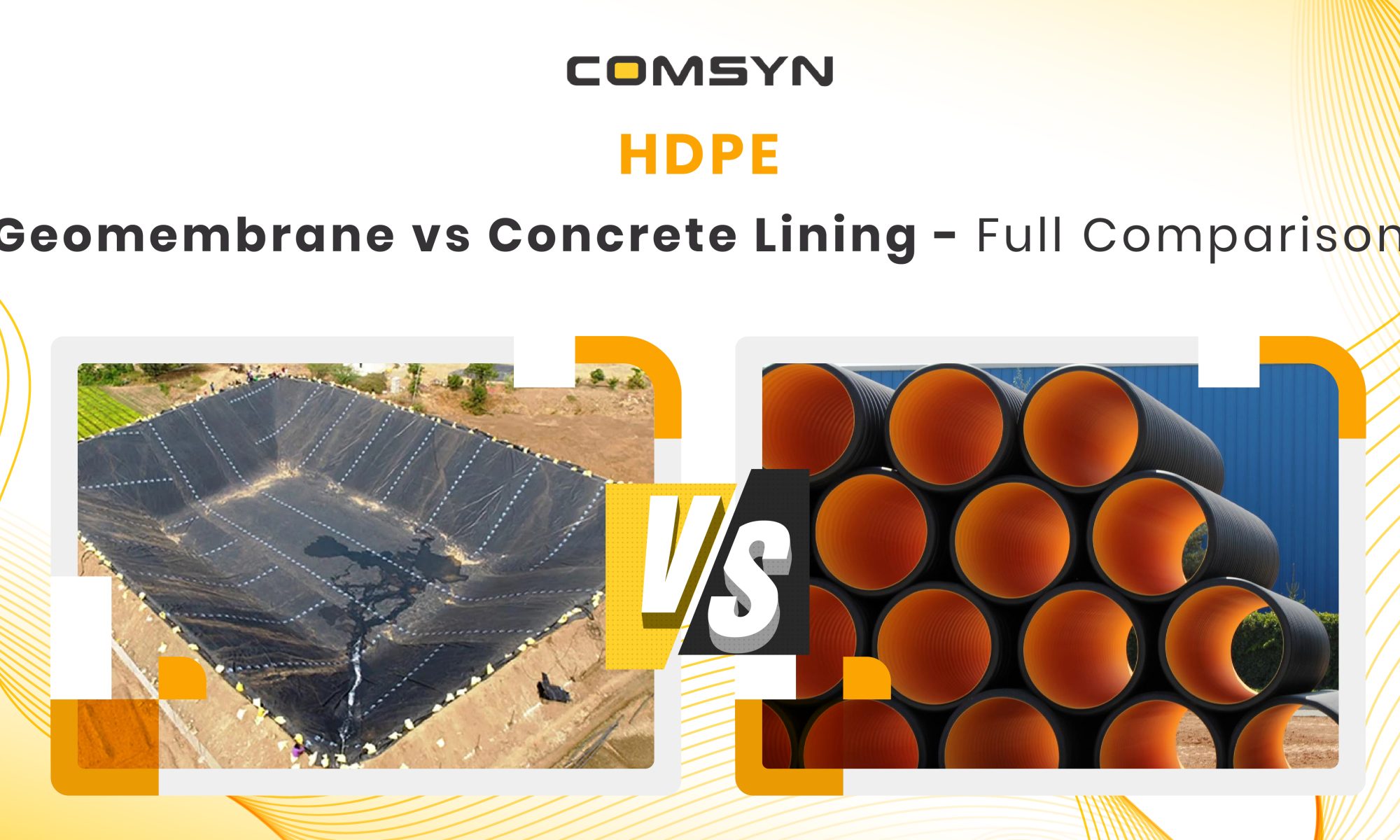
With increasing global demand for water, industries and governments across the globe are being called upon to develop zero-leak, long-lasting, and environmentally responsible containment systems for water. From reservoirs to canals to waste dump sites to aquaculture ponds and to industrial wastewater lagoons, the need is to ensure that every drop of water counts! Concrete lining has been the default choice for many years. However, considering the current scarcity of water and the ever-increasing prices of construction materials, project owners are rapidly migrating to engineered solutions such as geomembrane systems of HDPE, which can offer an almost complete elimination of leakage and a significantly better rate of durability. Comsyn has been able to produce and offer geomembranes manufactured from HDPE with a zero-leakage capability in 40 or more countries. The purpose of this blog is to examine and compare HDPE geomembranes to concrete lining so you can make an informed decision on constructing sustainable infrastructure for the future. Seepage is an unavoidable cost of containment structures. When concrete is used in the construction of a containment facility, the concrete’s porosity is a significant factor that impacts performance. In addition to concrete’s inherent porosity, micro-cracking, joints, and concrete’s tendency to shrink as it cures can all contribute to seepage. Under normal soil conditions, water loss from concrete reservoirs will range between 15% and 40% depending on the age of the structure. Therefore, for an average 10 million litre reservoir, between 1.5 million and 4 million litres of water may be lost each year, resulting in a considerable cost of operation. With a properly fused HDPE geomembrane, the membrane itself has no pores or joints, which means that there will be virtually zero seepage. The negligible leakage after decades of use is because water cannot pass through the material; therefore, the use of an HDPE geomembrane is unmatched when it comes to conserving water over a long period of time. The degradation of concrete occurs as a result of: Modern HDPE geomembranes are produced through design and engineering to offer extraordinary durability. With adequate installation and protection from UV, HDPE geomembranes provide 50 to 100+ years of service life. This is double or even three times longer than that provided by concrete. Concrete Timelines Concrete lining takes approximately: Completing all the above processes can take an average of 60 to 120 days. Delays may occur from weather and and coordination of multiple vendors. Compared to concrete-lining methods, HDPE geomembrane installations can be completed much faster, with fewer errors and less risk. The timelines for installing HDPE geomembrane consist of: CONSTRUCTION QUALITY ASSURANCE (CQA) testing is required during installation The total installation timeframe may vary depending on the specific size of the project; however, the total installation may be completed in as little as 7-10 days, and as long as 21 days, depending on size. Using HDPE to construct a geometric membrane allows your assets to begin generating an income up to 80 percent sooner than the same asset constructed using concrete. Concrete is solid and rigid. When the ground shifts or settles, the cracks form immediately and can create: HDPE has the ability to elongate from 500 to 700 times before failure. The ability to elongate allows HDPE to absorb settlement. Additionally, HDPE is capable of resisting seismic activity and sustaining the weight of soil and soil when subsidence occurs. In the case of soft soil conditions or earthquake-prone areas, HDPE is the clear choice among all materials. The cost to install could be misleading. To perform an accurate analysis, you must look at the total life cycle of the product. Costs of Concrete As a result, the overall cost of Concrete will be much higher over the long term. Costs of HDPE Geomembranes Over 25 years, the cost of using HDPE will be 40-60% lower than using concrete. Sustainable practices have become an important decision factor when planning infrastructure projects in today’s world. Carbon Footprints Natural Resource Usage End-of-Life Impact Water Conservation The HDPE lining conserves billions of litres of seepage each year. As a result, HDPE is one of the most/environmentally friendly water conservation construction materials available today. Maintenance frequency is nearly zero. Comsyn is an innovator and leader in the world of High-Density Polyethylene (HDPE) Geomembrane Solutions, as it has been doing for over 25 years. And, as we are confident in the performance of our systems, we back them with a Zero Failure Guarantee. Our systems have performed for many years in: We offer our customers the fastest delivery and support for their projects, with ready stock and 24×7 assistance for every phase of their project, including rapid mobilisation for urgent jobs. As we move into a new era of water and waste management with an increasing emphasis on environmentally safe and reliable methods, the evidence is overwhelming that HDPE geomembranes have surpassed traditional concrete liners in all aspects since 2026. From protection of the environment and conservation of water to long-term durability, more efficient installation, and lower total cost of ownership, it is clear that HDPE will be the primary geomembrane material in future development efforts. Comsyn offers the highest quality of HDPE geomembranes available for those seeking complete zero-leakage performance, fast installation times, extended life cycles, and maximum return on investment (ROI). (1) So, is it possible to place a new HDPE liner on top of a cracked concrete liner? Yes. It is possible to install an HDPE liner on top of a cracked concrete liner without the need to remove the old concrete liner by using the necessary surface preparation, including the use of cushioning by a geotextile, to create a cushion between the concrete and the HDPE liner. This method will save both time and money. (2) Is it true that rods or rocks can damage the HDPE geomembrane? If the proper preparation of the subgrade is performed and protective layers are used (geotextile, sand bedding), then yes, the HDPE geomembrane is very well protected. Additionally, HDPE geomembranes are very resistant to punctures from sharp objects, including rocks, and very resistant to damage from bioactivity (rodents). (3) Can HDPE geomembranes be used in drinking water or aquaculture applications without any concerns? Absolutely. HDPE geomembranes are “food grade,” non-toxic, and are widely used in drinking water and aquaculture projects around the world. (4) How do HDPE geomembranes perform in extreme environments (low temperatures to high temperatures)? Due to its thermal stability and flexibility, HDPE geomembranes perform well in environments of freezing to very hot (desert conditions) and in very high UV environments. (5) Can HDPE geomembranes be used in environments contaminated by chemicals, such as mining or industrial mining lagoons? Yes. HDPE geomembranes are chemically inert and, therefore, are very well suited for containment of aggressive leachate solutions, strong acids, strong bases (alkaline) solutions, and chemicals that have a very high pH level.HDPE Geomembrane vs Concrete Lining – Full Comparison (2026 Guide)
How Much Water Do You Actually Lose with Each Lining Method?
Which Material Lasts Longer in Real-World Conditions?
Concrete
HDPE Geomembrane
How Fast Can You Complete the Project and Start Using It?
HDPE Geomembrane Timelines
Which Solution Handles Ground Movement and Earthquakes Better?
Concrete
HDPE Geomembrane
How Do Total Costs Compare Over 20–30 Years?
Which Is More Environmentally Friendly?
How Easy Is Repair and Maintenance?
Concrete Repairs
HDPE Geomembrane Repairs
Comsyn – Your Trusted HDPE Geomembrane Partner
Quick Decision Table – HDPE Geomembrane vs Concrete at a Glance
Parameter
HDPE Geomembrane (Comsyn)
Concrete Lining
Winner
Water Seepage Loss
Virtually 0%
15–40%
HDPE
Expected Service Life
50–100+ years
15–30 years
HDPE
Installation Time
7–21 days
60–120 days
HDPE
Resistance to Ground Movement
Excellent (500–700% elongation)
Poor (cracks easily)
HDPE
Repair Complexity & Cost
Simple extrusion weld, low cost
Expensive, needs heavy machinery
HDPE
Life-Cycle Cost (25 years)
Lower (savings from zero leakage)
Higher (repairs + water loss)
HDPE
Carbon Footprint
80–90% lower
Very high (cement production)
HDPE
Recyclability
100% recyclable
Non-recyclable waste
HDPE
Maintenance Requirement
Almost zero
Regular crack sealing & patching
HDPE
Conclusion
FAQs

- About Us
- Products
- Markets Served
-
- Investor Relation
- Board Of Directors
- Committees Of Board
- Corporate Governance
- Financials
- Annual Report
- Key Managerial Positions
- Shareholding Pattern
- Notices
- Policies Programme
- Announcements
- Statement of Investor Complaints
- Unpaid & Unclaimed Dividend
- Prospectus
- Investors Contact
- Subsidiary Financials
- IEPF
- Preferential Issue – 2024
- MOA & AOA
- Integrated Filing
- Sustainability
- Contact Us
- TechTex
- Brochure
